
1
/
of
1
Clown Knifefish (Chitala ornata)
Clown Knifefish (Chitala ornata)
Regular price
$80.00 NZD
Regular price
Sale price
$80.00 NZD
Unit price
/
per
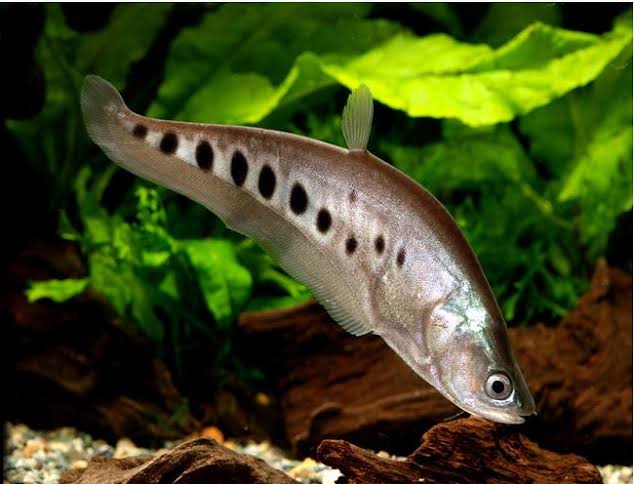
The clown knife fish (Chitala ornata), also known as the clown featherback or spotted knifefish, is a large, nocturnal tropical freshwater predator native to Southeast Asia. Named for its long, flattened, blade-like body, it is a striking species known for its distinctive row of eye-like spots and ability to glide forward and backward through the water.
Physical Characteristics
- Body Shape. It has an elongated, deeply compressed body with a pronounced humped back that tapers toward the tail.
- Fins. A long, continuous anal fin runs along most of its underside and ripples in a wave-like motion for movement. In contrast, its dorsal fin is extremely small and resembles a tiny feather or tuft.
- Coloration and Markings. Adults are typically silvery-grey and develop a horizontal row of large black spots ringed in white along the lower rear portion of the body. Juveniles start with diagonal stripes that gradually break into these signature spots as they mature.
- Size. While commonly sold small in the aquarium trade, they grow rapidly and can reach up to 1 meter (3.3 feet) in length in the wild.
Habitat and Distribution
- Native Range. They originate from slow-moving or still freshwater rivers, lakes, canals, and swamps in Cambodia, Laos, Thailand, and Vietnam.
- Invasive Status. Due to accidental escapes and intentional aquarium releases, they have become established invasive predators in regions outside their native range, notably in South Florida waterways and the Philippines.
- Adaptations. They are bimodal air-breathers, meaning they can gulp air at the water's surface to survive in warm, stagnant waters with very low dissolved oxygen.
Behavior and Diet
- Nocturnal Predators. Clown knifefish are largely shy during the day and prefer hiding near submerged wood, vegetation, or shaded structures. They emerge at dusk and night to hunt.
- Diet. They are carnivorous ambush predators with large, gaping mouths lined with small conical teeth. Their diet consists mainly of smaller fish, crustaceans, aquatic insects, and mollusks.
- Unique Locomotion. By undulating their long bottom fin, they can maneuver with high precision in tight spaces and swim smoothly in reverse.
Aquarium Care Overview
- Space Requirements. Because of their massive adult size, they outgrow standard home aquariums and require gigantic tanks or indoor tropical ponds.
- Temperament. They are generally peaceful toward tankmates too large to swallow, though they can be territorial toward other knifefish or similarly shaped species.
- Environment. They thrive in dimly lit setups with plenty of caves or driftwood for cover, calm water flow, and temperatures between 24°C and 28°C (75°F–82°F).
Share