
1
/
of
1
Croaking Gourami (Trichopsis vittata)
Croaking Gourami (Trichopsis vittata)
Regular price
$14.00 NZD
Regular price
Sale price
$14.00 NZD
Unit price
/
per
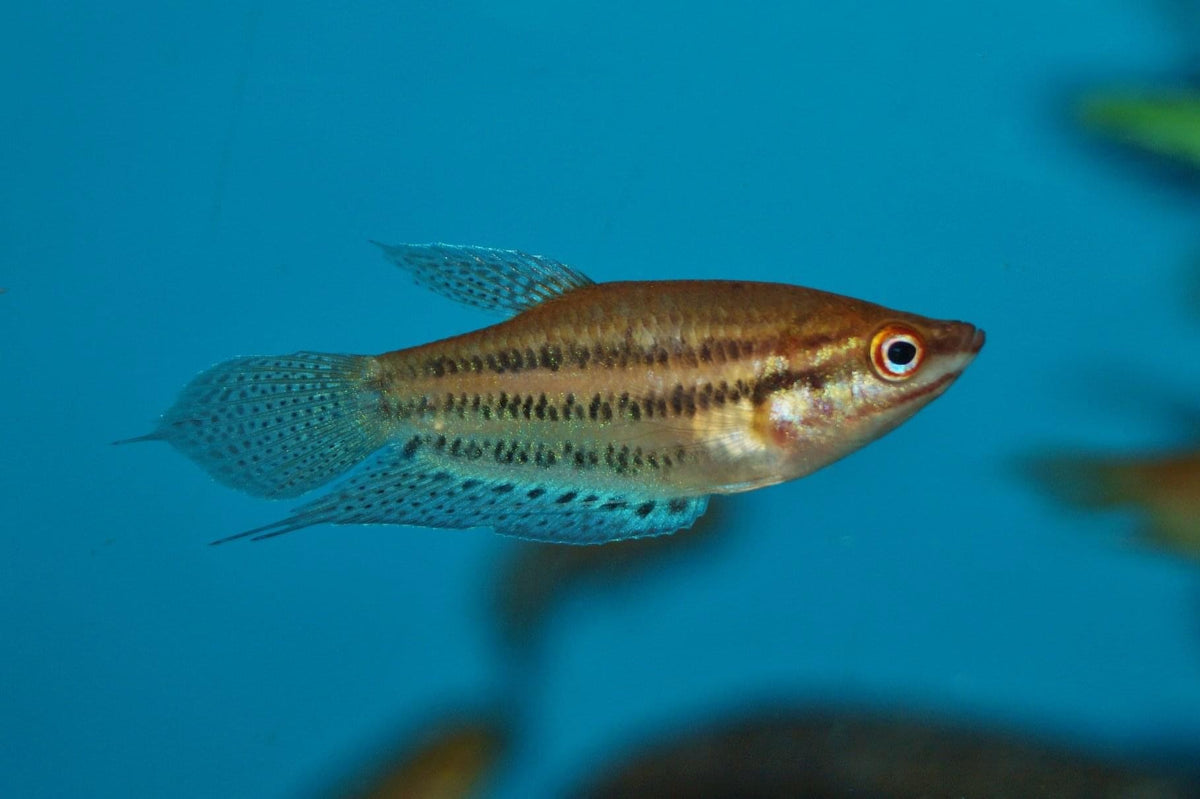
The croaking gourami (Trichopsis vittata) is a small, peaceful freshwater labyrinth fish from Southeast Asia famous for producing an audible croaking or purring sound. It grows up to 7 cm (2.8 inches) in length and typically lives for 3 to 5 years.
Physical Appearance
- Body and Coloration. It has a sleek, elongated body with highly variable coloration ranging from pale brown and olive green to iridescent dark purple. Two to four dark brown or black horizontal stripes or rows of spots run along its flanks.
- Fins and Eyes. Its fins often feature red or dark spots. Its iris is typically a striking bright blue or purple.
- Sexual Dimorphism. Males grow slightly larger than females and develop more vibrant coloration. Males also have extended, pointed rays on their dorsal, anal, and caudal fins.
Unique Traits & Behavior
- Vocalization. Both sexes make a distinct rattling or croaking noise by rapidly beating their pectoral fins to pluck specialized, thickened tendons. This sound is loud enough to hear outside the tank and is used during courtship and territorial disputes. [1, 2]
- Labyrinth Organ. Like other gouramis, it possesses a labyrinth organ that allows it to breathe atmospheric air directly from the water's surface. This adaptation helps it survive in warm, oxygen-poor waters in the wild.
- Temperament. It is a shy, peaceful fish that does best in small groups within a quiet community tank. Males may bicker and flare at each other during breeding, though they rarely cause physical harm if given enough space and cover.
Natural Habitat & Aquarium Care
- Native Range. This species is native to slow-moving, heavily vegetated lowland waters such as rice paddies, swamps, and streams across Thailand, Vietnam, Cambodia, Malaysia, Singapore, and Indonesia.
- Tank Setup. A minimum tank size of 40 to 67 liters (11 to 18 gallons) is recommended, featuring dense planting, floating surface plants, dark substrate, and gentle water flow. A tight-fitting lid is essential to keep the air above the water warm and humid, which prevents damage to its labyrinth organ.
- Water Parameters. They thrive in water temperatures between 22°C and 28°C (72°F–82°F) with a slightly acidic to neutral pH of 6.0 to 7.5.
- Diet. In the wild, it is a micro-predator that eats insects, larvae, and small crustaceans. In an aquarium, it accepts high-quality flakes and micro-pellets supplemented with live or frozen foods like bloodworms, daphnia, and brine shrimp.
- Breeding. During spawning, the male builds a bubble nest under broad leaves or floating plants. After the pair embraces and releases up to 200 eggs, the male collects the eggs in his mouth and places them in the nest, guarding them until the fry become free-swimming.
Share