
1
/
of
1
Pearl Geophagus (Geophagus brasiliensis)
Pearl Geophagus (Geophagus brasiliensis)
Regular price
$21.00 NZD
Regular price
Sale price
$21.00 NZD
Unit price
/
per
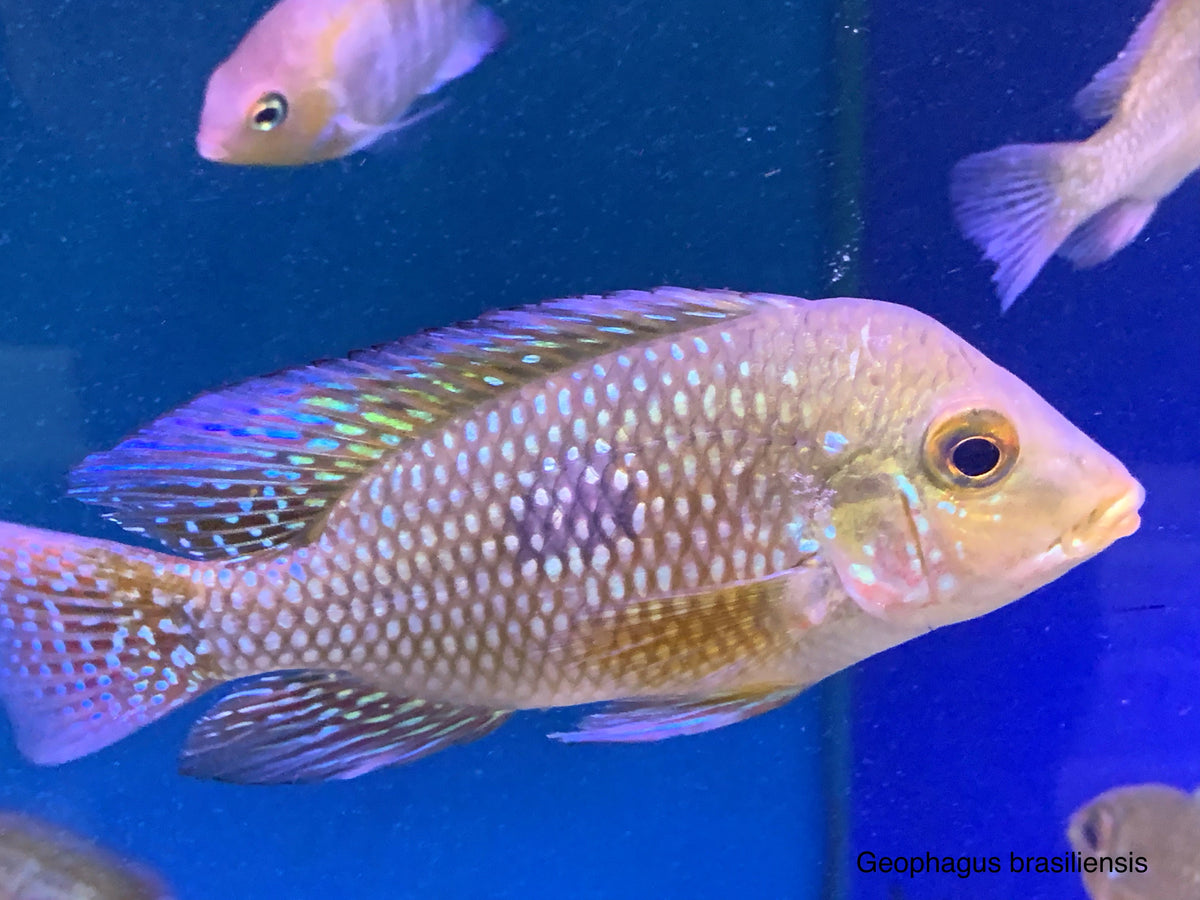
The Pearl Cichlid (Geophagus brasiliensis), also called the Pearl Eartheater, is a large, territorial south American cichlid known for its iridescent blue-spotted scales and red fins. Unlike true eartheaters in the same genus, it is a hardy habitat generalist that behaves more like a traditional, semi-aggressive Central or South American cichlid
Physical Appearance & Size
- Coloration. Its base body colour shifts between pale brown, grey-green, and dark blue-purple depending on mood and breeding state. Bright, pearlescent blue speckles cover the flanks, paired with red fins that often feature black tips.
- Markings. A distinct dark spot sits near the middle of the body or toward the tail. Faint vertical black bands also appear along the sides.
- Adult Size & Dimorphism. Males grow rapidly and reach 25–30 cm (10–12 inches), while females typically stay closer to half that size. Dominant mature males also develop a pronounced nuchal hump on the forehead.
- Lifespan. With proper care, they can live up to 15 years.
Habitat & Distribution
- Native Range. This species originates from coastal rivers, lakes, and slightly brackish lagoons across eastern and southern Brazil, Uruguay, Paraguay, and northeastern Argentina.
- Invasive Populations. Because they tolerate cold water down to 10°C and even full-strength seawater, feral populations have established in parts of Australia, the United States, Taiwan, and the Philippines.
Behaviour & Aquarium Care
- Temperament. They are significantly more aggressive and territorial than other Geophagus species, especially when guarding eggs or fry. Keep them singly, as a bonded pair, or alongside similarly robust cichlids, large characins, and armoured catfish.
- Tank Setup. A single adult requires at least a 200–300 litre (55–80 gallon) aquarium, with larger footprints needed for pairs or tankmates. Provide a soft sand substrate for digging, driftwood, and rocky caves.
- Plants. Avoid rooted substrate plants because these fish dig aggressively. Hardy epiphytes like Java fern and Anubias attached to hardscape work best.
- Water Parameters. They thrive in temperatures of 18–26°C (64–79°F), a pH of 6.0–7.5, and soft to moderately hard water (up to 15 dGH).
- Diet. As generalised omnivores, they readily accept quality cichlid pellets, flakes, frozen bloodworms, brine shrimp, earthworms, and occasional vegetable matter.
Share