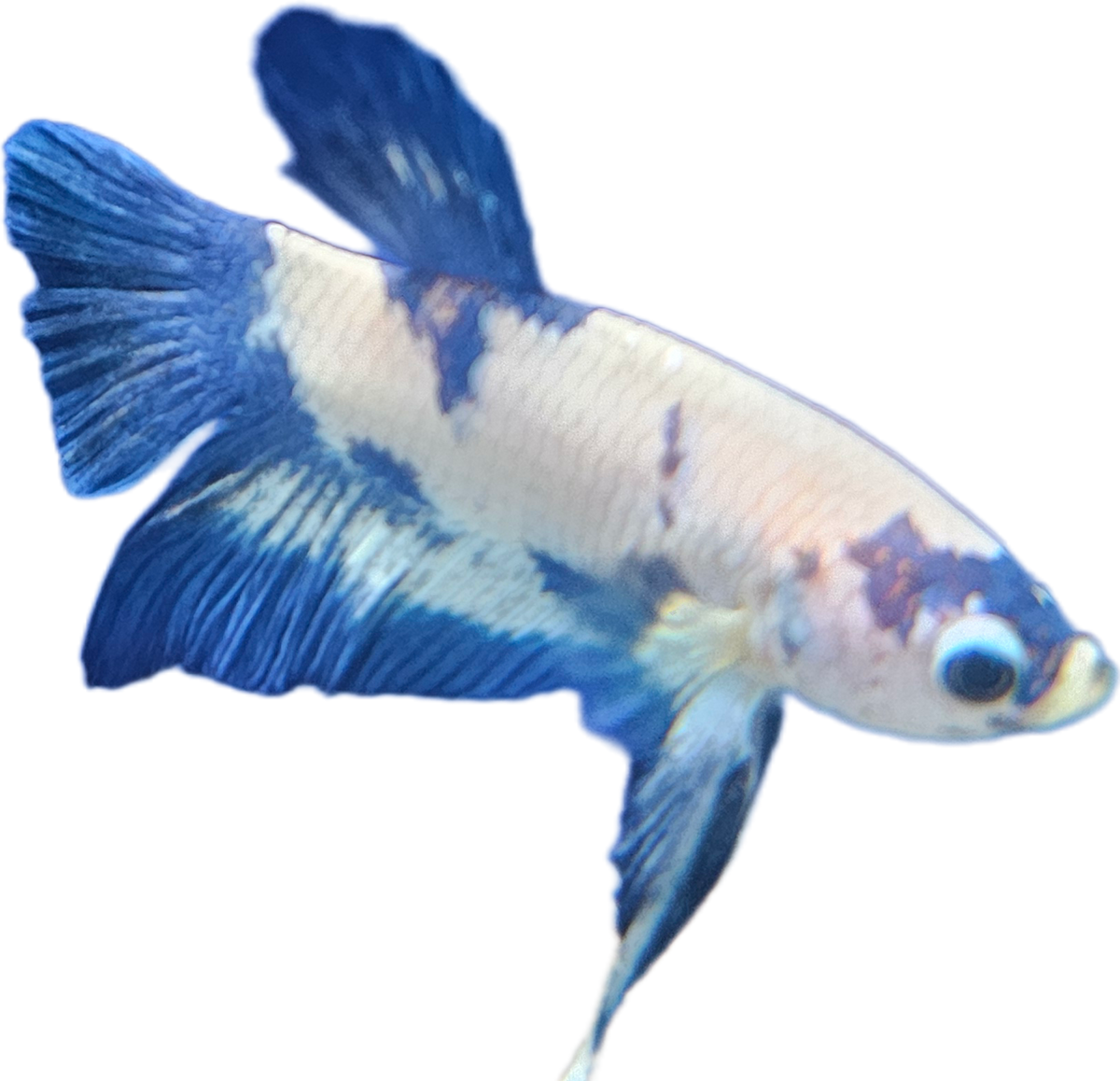

HMPK Blue Marble Dot Betta wysiwyg #3
HMPK Blue Marble Dot Betta wysiwyg #3
An HMPK (Halfmoon Plakat) Betta is a popular domestic variety of Siamese fighting fish (Betta splendens) bred to combine a short, muscular body with a dramatic, symmetrical tail spread. Unlike traditional long-finned bettas, HMPKs retain shorter, sturdier fins closer to their wild ancestors while flaring their caudal (tail) fin to a full 180-degree half-circle.
Physical Characteristics
• Tail and Fin Shape. The caudal fin spreads to a crisp 180-degree "D" shape when flaring, overlapping cleanly with the dorsal and anal fins. The fins remain short and compact, preventing the heavy dragging common in long-finned strains.
• Body Proportions. They have a stout, athletic, and compact build. Adult HMPK bettas typically reach 6 to 7 cm (2.5 to 3 inches) in length.
• Color and Pattern Varieties. Selective breeding has produced countless striking morphs, including Koi, Galaxy, Samurai, Dragon Scale, Nemo, Avatar, and solid metallic shades.
• Giant Variants. Some breeders specialize in "Giant HMPKs," which share the same fin proportions but grow larger than 7.5 cm (3 inches).
Behavior and Temperament
• High Activity Level. Because they are not weighed down by long, flowing fins, HMPKs are fast, agile, and energetic swimmers.
• Reduced Fin Issues. Their shorter finnage makes them far less prone to fin nipping, tearing on decor, or developing fin rot compared to long-finned varieties.
• Territorial Nature. Like all Betta splendens, males are aggressive toward other male bettas and must be housed singly. They can sometimes coexist with peaceful, non-nippy tank mates in spacious, planted aquariums.
Quick Care Overview
• Lifespan. Typically 2 to 4 years (occasionally up to 5) with proper care.
• Tank Setup. A minimum of 10 to 20 liters (approx. 3 to 5 gallons) is recommended, equipped with a heater and gentle filtration. Because they are active swimmers, horizontal swimming space is beneficial.
• Water Parameters. They thrive in warm freshwater between 24°C and 28°C with a pH of 6.5 to 7.5.
• Diet. As carnivores, they require high-protein betta pellets supplemented with frozen or live foods like bloodworms, brine shrimp, and daphnia.
Share